
Cement Industry Emission Reduction with MECS® DynaWave® Technology
Cement
Cement Industry Emissions and Particulate Reduction with MECS® DynaWave® Technology
The cement industry faces unique environmental challenges for the clinker burning process. Cement kiln facility regulated emissions include potentially high inlet SO2,abrasive particulate and traces of metal. This creates a challenging application for wet gas scrubbers, which must take into consideration possible corrosion, erosion and plugging.
The major environmental problem to address is SO2 emissions control from the pre-heater exhaust or directly from the kiln. This results in the formation of SO2. The exhaust from the pre-heater contains this SO2 as well as abrasive dust (particulate) from the raw materials. If SO2 is released into the atmosphere, it will react with atmospheric water vapor to form H2SO4 and produce acid rain.
Cement plant applications are erosive, tough applications which can severely erode equipment not properly designed with this environment in mind. Air pollution control in a cement plant is no different, and careful selection of technology, designed specifically with cement plants in mind, is the path to reduced maintenance and worry-free operation. The DynaWave® wet gas scrubbing technology offers cement plants proven performance in this difficult application.
Cement Industry Emissions Reductions Solution
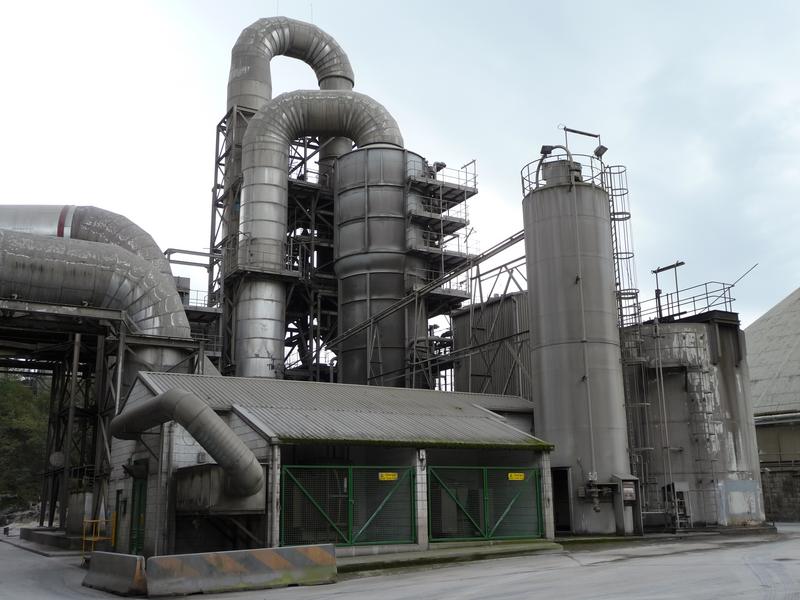
MECS® DynaWave® Wet Gas Scrubber
The cement kiln gas stream is hot and contains SO2, HCl and particulate. The DynaWave® unit quenches the gas and removes acid gases and particulate all in one vessel, saving on footprint and capital costs. Operational expenses are minimal as Cement Kiln Dust (CKD) can be used as a reagent for the DynaWave® scrubber.
The gypsum produced via in-situ oxidation can be reused in the cement process, making it an effluent-free system. Further details can be found in the DynaWave® reverse jet scrubber for the cement industry brochure.
The MECS® DynaWave® wet gas scrubbing technology has proven robustness in cement FGD applications. The unique reverse jet technology offers high turndown (ability to combine kiln streams into one scrubber) and excellent SO2 removal even at very high inlet loadings. Efficient utilization of limestone and lime (effectively 1:1) allows use of the least expensive reagent, offering significant cost savings. Custom-designed DynaWave® solutions can offer a 99+% removal efficiency for SO2 and up to 98% removal efficiency for dust particles.
A Unique Reverse Jet Technology
Why Choose DynaWave® Technology In This Application?
- High SO2 removal efficiency
- Large-bore nozzles and open design essentially eliminate plugging, even with sticky particles and slurries containing up to 30% solids. This is a plus when downtime for repair and maintenance is a concern
- Slurry design is based on experience and success in cement applications
- Smaller diameter and lower height compared to typical spray towers mean less capital cost
- Can handle massive amounts of solids entering scrubber from upstream baghouse or ESP failures and continue to operate without interruption
- Ability to utilize reagents such as limestone and CKD directly in the scrubber
- Protection against corrosion, erosion and plugging: a) Since dissolved SO2 forms corrosive, weak sulfurous acid, the typical material of construction chosen for the vessel and piping is FRP; b) Erosion is handled by use of special nickel hardened alloy for slurry pumps; slurry piping design and silicon carbide reverse jet nozzles; c) Plugging is controlled by large-bore reverse jet nozzles and piping design that discourages settling
- Simplicity in operation with low operator attention required and high reliability
- Five DynaWave® scrubbers on cement plants using CKD as reagent
- Out of the more than 500 wet gas scrubbers designed by Elessent Clean Technologies, more than 400 units are based on DynaWave® wet scrubbing technology
Our extensive experience in cement industry applications avoids problems associated with slurry abrasion and solids buildup. Holcim and Castle Cement are among the cement industry leaders who recognize DynaWave® benefits in their FGD applications. For further details on the use of DynaWave® technology by the cement industry to achieve high SO2 removal, see a case study:
 English
  Chinese